Hybrid Calculator
A dealership sales tool that answers the one question every hybrid customer asks — does it actually pay off. Enter two vehicles, get annual savings, 5-year net, and a break-even date.
Every hybrid conversation with a customer ends the same way: "so will it actually save me money?" I built a tool that answers that in one screen, instead of on the back of a receipt.
Live tool: https://hybrid.harryludemann.com
The problem
I'm a sales consultant at Armstrongs. Part of that job is standing next to a customer who's cross-shopping a hybrid against a petrol equivalent, and they always ask the same thing: how long until the extra money I'm spending upfront actually comes back to me.
The honest answer depends on four things — how far they drive, what fuel costs, how thirsty each vehicle actually is, and the price gap between the two. Doing that math on the spot, in your head, in front of a customer, is how you end up rounding badly or just guessing. And "it'll pay for itself eventually" isn't an answer anyone drives away confident about.
I needed something I could pull up on a phone or tablet mid-conversation, plug in real numbers, and get a straight answer — not a brochure line about "class-leading efficiency."
What it does
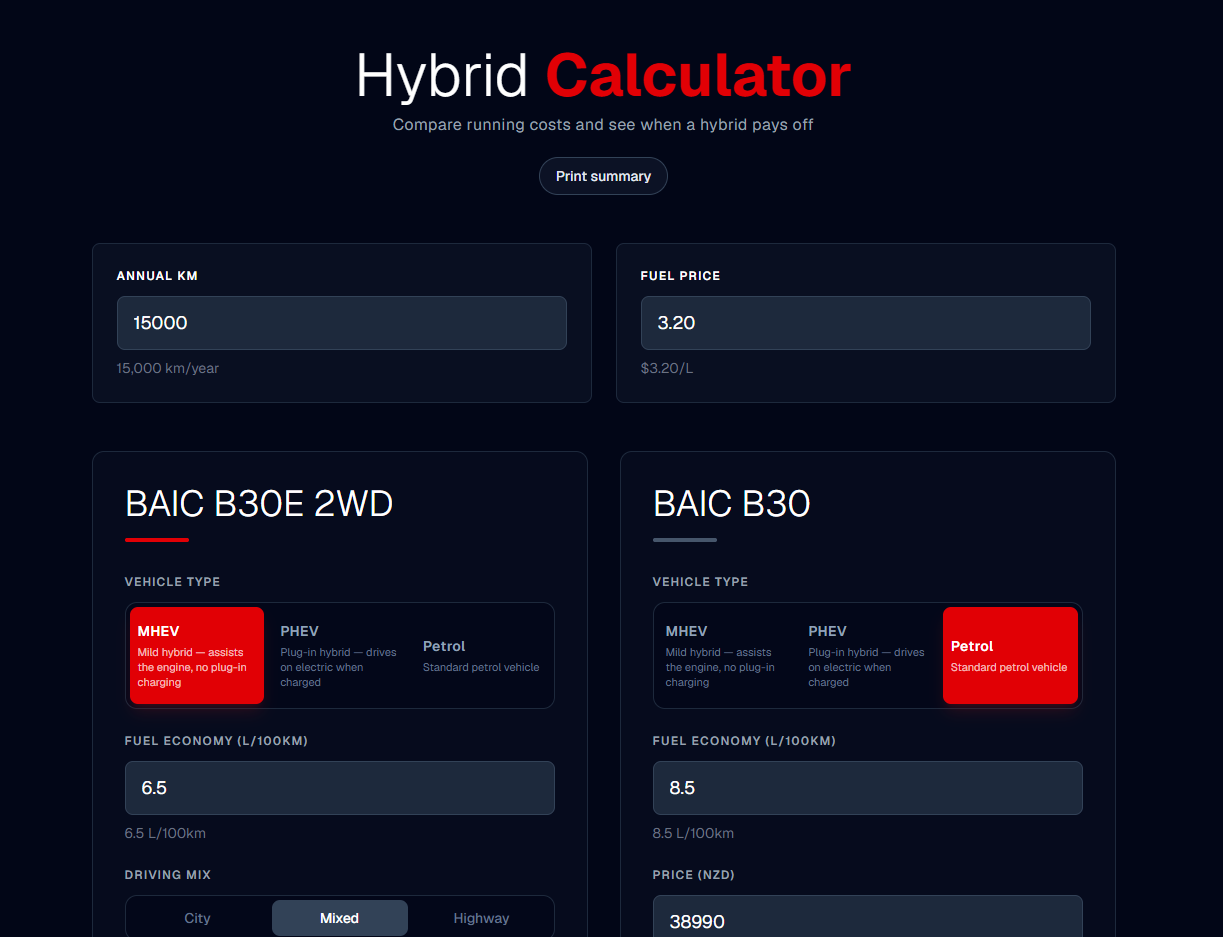
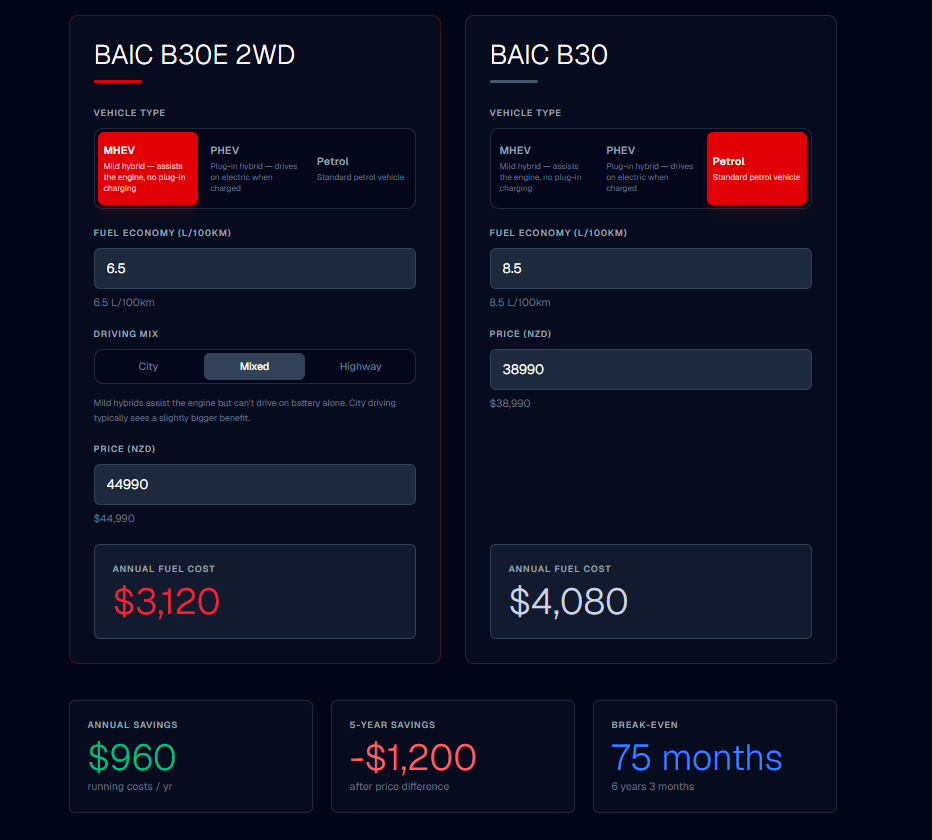
You put in two vehicles side by side. Each one gets:
- Vehicle type — mild hybrid, plug-in hybrid, or standard petrol
- Fuel economy (L/100km)
- Price
- Driving mix, where it matters (mild hybrids lean more on the engine, so city vs highway shifts the real-world number)
Set annual kilometres and a fuel price once, and it applies to both.
The output is the part that actually settles the conversation:
- Annual fuel cost for each vehicle
- Annual savings — what the more efficient one saves you every year
- 5-year savings — fuel savings minus the price premium, so you can see if you're actually ahead or still behind after five years
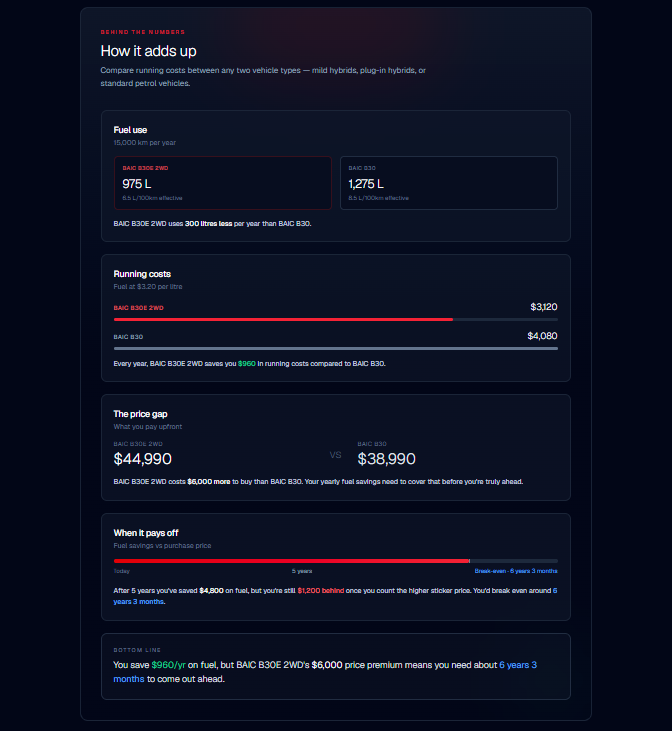
- Break-even — the point where cumulative fuel savings catch up to the higher purchase price, in months and years
That last number is the one that matters most, and it's the one people never do the maths on themselves. A hybrid that saves $840 a year but costs $6,000 more doesn't pay for itself in three years. It takes over seven. The calculator says that plainly instead of letting "hybrid = cheaper" sit unchallenged.
Why break-even, not just savings
Most fuel calculators stop at "you'll save $X a year," which is technically true and practically misleading. It ignores the fact you paid more to get there.
This one plots it out: today, five years, and the break-even point on a line, so a customer can see the shape of it — the gap that has to close before the higher price actually pays off, and how long that takes at their driving habits, not average ones.
Sometimes that number makes the hybrid look better than they expected. Sometimes it makes the petrol option the more sensible one for someone doing low annual kilometres. Either way, it's their numbers, not a marketing assumption.
Built for the conversation, not a report
A few things came out of actually using this on a sales floor rather than just building it and hoping:
- Print summary — a customer can walk away with the numbers on paper, not have to remember them
- Runs on the numbers you enter — no hidden national averages standing in for their actual commute
- Fast to fill in — sliders and toggles, not a form with twelve fields, because this happens standing up, not at a desk
- Clear disclaimer — it's an estimate based on inputs, not financial advice, and it says so
Under the hood it's a small, fast, single-purpose web app — no login, no data stored, nothing to maintain beyond the fuel-price default drifting with reality every so often.
Who this is for
Built it for my own conversations, but the problem isn't specific to Armstrongs or to me. Anyone selling — or buying — a hybrid against a petrol equivalent is having some version of this same conversation, usually with worse maths than this.
If you're in dealership sales and want your own version — different currency, different vehicle categories, your own branding — that's a small build, not a big one. The logic's already done.